
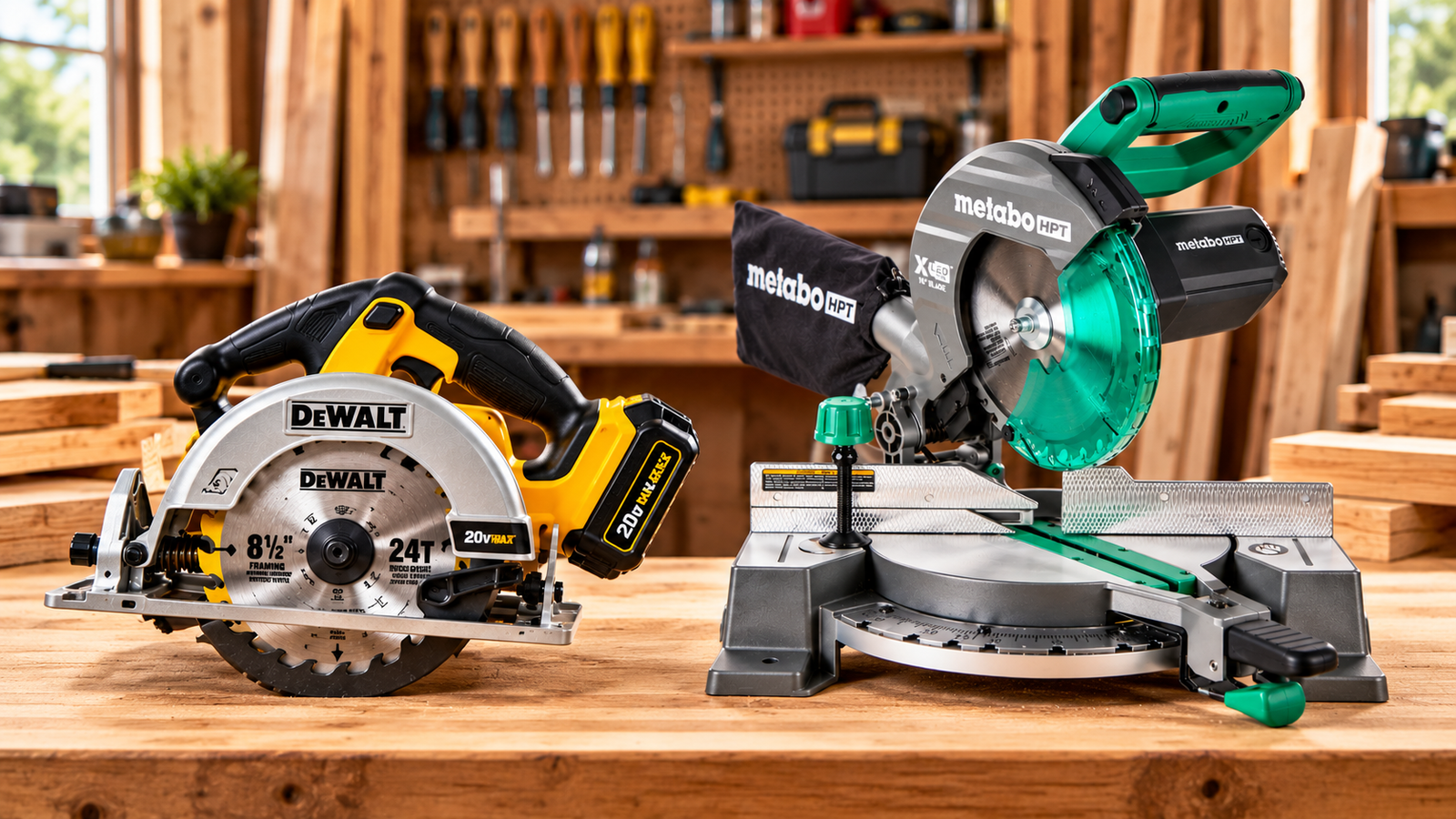
Circular saws and miter saws can both make accurate cuts in wood, but they are designed around different ways of working. A circular saw is portable and moves across the material, while a miter saw remains in a fixed position and brings the blade down through the workpiece.
Understanding the differences between a circular saw and a miter saw can help you choose the tool that better matches your projects, workspace, cutting requirements, and budget.
Circular Saw vs. Miter Saw: What Is the Difference?
The biggest difference is how the tool interacts with the material. With a circular saw, you normally move the saw across a stationary workpiece. With a miter saw, the saw is mounted to a base and the workpiece is positioned against the saw’s fence.
- Circular saws are portable and versatile
- Miter saws provide a fixed cutting station
- Circular saws can handle large sheet materials
- Miter saws are convenient for repeated crosscuts
- Both can make straight cuts when properly set up
- The better choice depends on the project
Neither tool automatically replaces the other. Their different designs make each one more convenient for particular woodworking operations.
Circular Saw and Miter Saw Options to Consider
Disclosure: The product links below are paid affiliate links. As an Amazon Associate I earn from qualifying purchases.
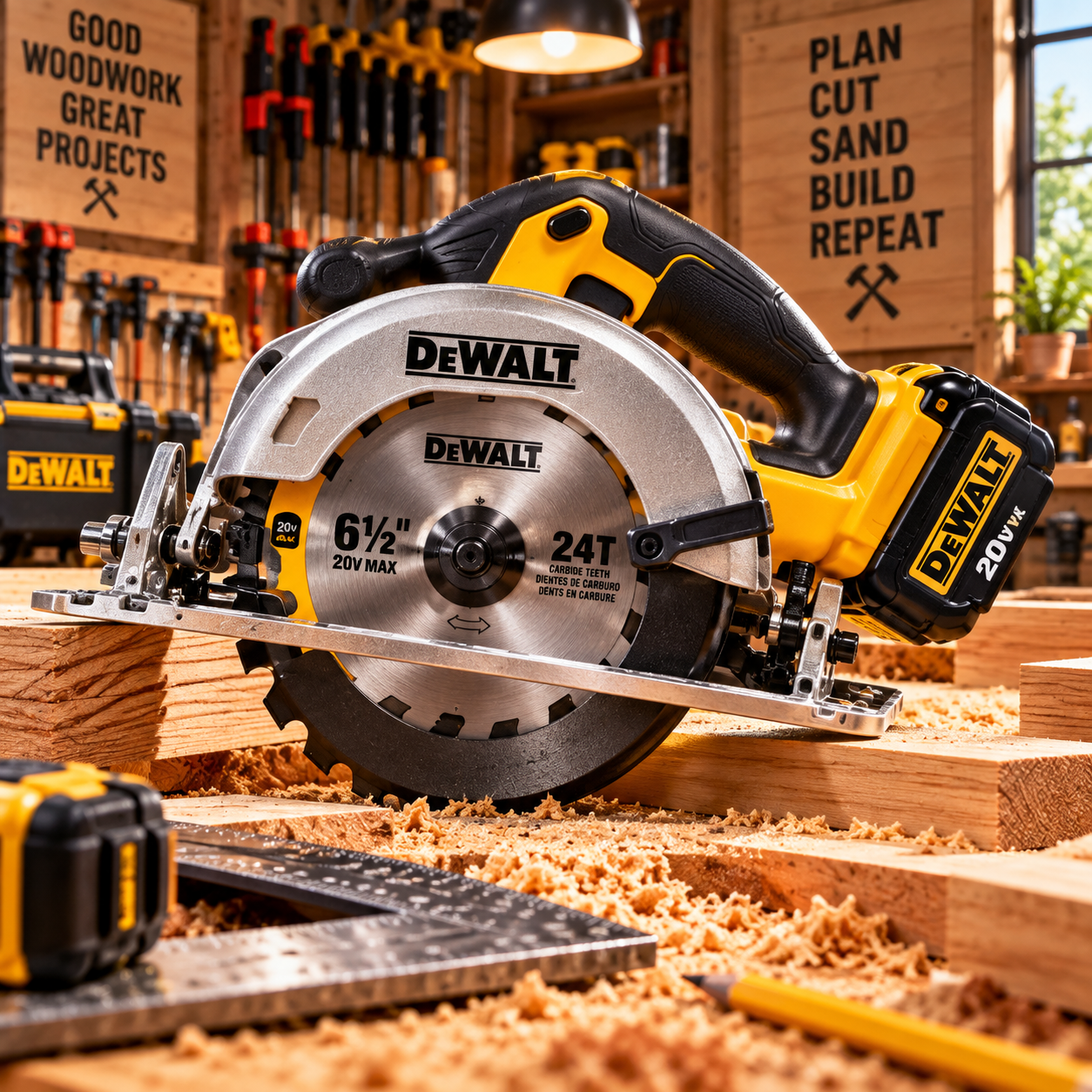
DEWALT 20V MAX Circular Saw DCS391B
A cordless circular saw option for portable straight cuts in lumber, plywood, and other suitable woodworking materials.
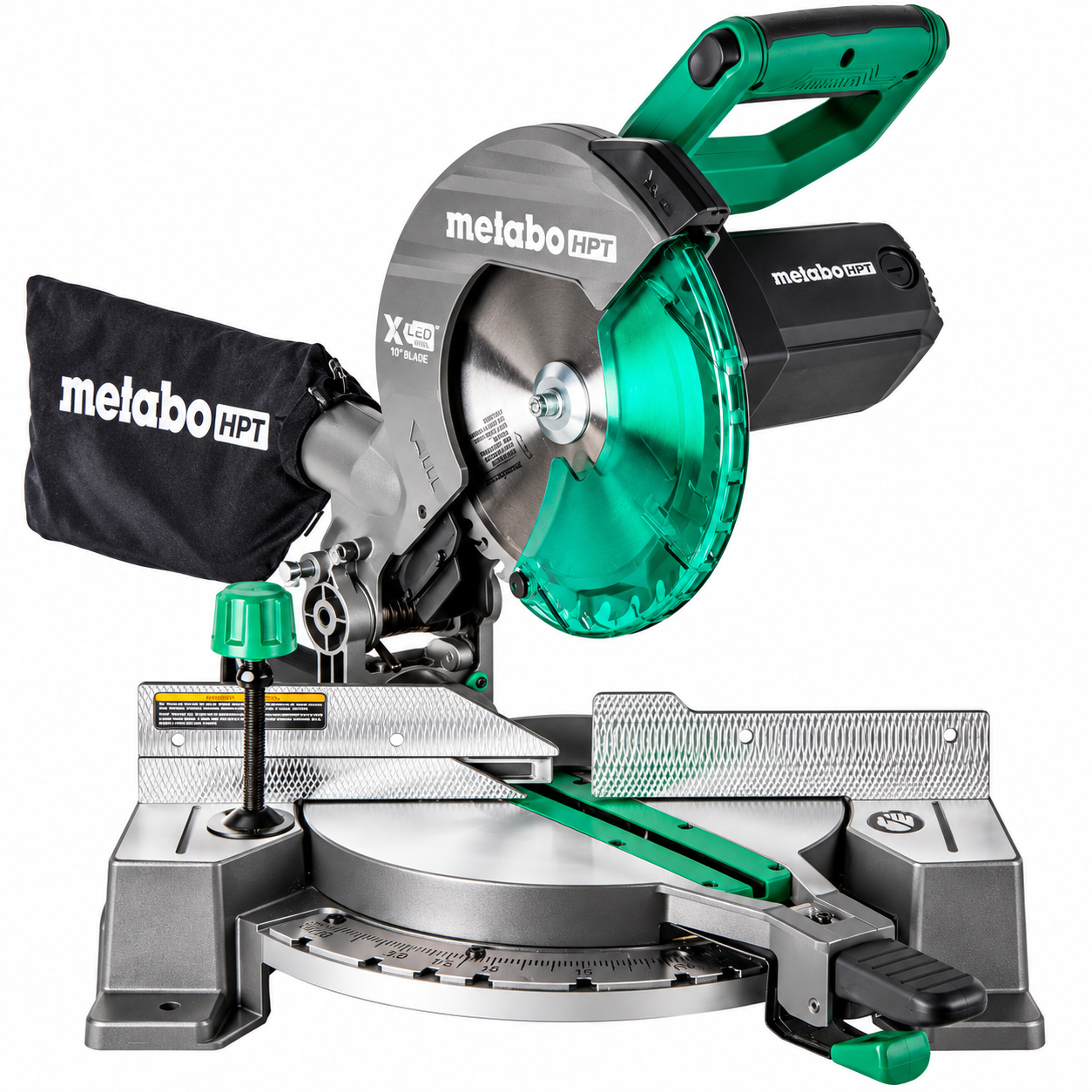
Metabo HPT 10-Inch Compound Miter Saw
A 15-amp single-bevel compound miter saw designed for controlled crosscuts, miter cuts, and common workshop cutting tasks.
1. What Is a Circular Saw?
A circular saw is a handheld power saw that uses a rotating circular blade. Instead of bringing material to a stationary cutting machine, the operator guides the saw through the workpiece.
Its portable design makes it useful in workshops, garages, construction areas, and other locations where moving a larger stationary saw would not be practical.
2. What Is a Miter Saw?
A miter saw is a stationary cutting tool with a blade assembly mounted above a base. The material rests against a fence while the blade is lowered through the workpiece.
This arrangement makes a miter saw particularly convenient when a project requires repeated crosscuts or cuts at controlled angles.
3. Circular Saws Are More Portable
Portability is one of the major advantages of a circular saw. The tool can be carried to large pieces of lumber or sheet material rather than requiring the material to be brought to a fixed cutting station.
A cordless circular saw can provide additional mobility because it does not need to remain connected to an electrical outlet during operation.
4. Miter Saws Create a Dedicated Cutting Station
A miter saw is normally positioned on a workbench, stand, or other stable support. Once the station is established, boards can be positioned against the fence and cut one after another.
This can make the workflow convenient when a project requires numerous pieces to be cut to similar lengths or angles.
5. Circular Saws Work Well With Large Sheet Materials
Plywood and other large panels can be difficult to move across a stationary cutting station. A circular saw allows the material to remain supported while the saw travels across it.
Using an appropriate straightedge or cutting guide can help produce more controlled straight cuts across sheet materials.
6. Miter Saws Are Designed for Crosscuts
Crosscutting means cutting across the width of a board. This is one of the operations for which a miter saw is commonly used.
The workpiece rests against the fence, allowing the operator to position the board and lower the blade through it at the selected cutting location.
7. Miter Saws Make Angled Cuts Convenient
The rotating table of a miter saw allows the cutting angle to be adjusted for miter cuts. This is useful for projects involving trim, frames, molding, and other assemblies that require angled joints.
A compound miter saw can also adjust the blade assembly for bevel-related cutting operations according to the capabilities of the particular model.
8. Circular Saws Can Make Angled Cuts Too
A circular saw is not limited to simple 90-degree cuts. Many circular saws allow the base or shoe to be adjusted for bevel cuts.
However, the cutting process is different from using a stationary miter saw because the operator still guides the circular saw through the material.
9. Which Saw Is Better for Long Straight Cuts?
A circular saw is generally more practical when making long cuts through sheet materials or larger workpieces that would be difficult to position on a miter saw.
A straightedge, guide, or compatible cutting system can help keep the saw traveling along the intended cut line.
10. Which Saw Is Better for Repeated Cuts?
A miter saw can be convenient when many boards need to be cut to the same length. A properly arranged cutting station can allow workpieces to be positioned consistently before each cut.
For repetitive woodworking tasks, this fixed setup may reduce the amount of measuring and repositioning required between cuts.
11. Which Saw Is Better for Trim Work?
Miter saws are commonly associated with trim work because they make crosscuts and angled cuts from a fixed cutting station.
Projects involving molding, frames, baseboards, and similar materials can benefit from the ability to set and repeat cutting angles.
12. Which Saw Is Better for Plywood?
A circular saw is usually the more practical of these two tools for breaking down large sheets of plywood because the saw moves across the material.
Supporting the sheet correctly and using a guide can make the process easier and help maintain control throughout the cut.
13. Which Saw Takes Up Less Workshop Space?
A circular saw is compact and can usually be stored on a shelf, in a cabinet, or in a tool bag when it is not being used.
A miter saw requires more dedicated operating space because the machine itself needs support and longer boards may extend significantly to either side of the cutting station.
14. Cordless vs. Corded Operation
Circular saws are widely available in cordless and corded configurations. Cordless models can be convenient when portability is important or when access to electrical outlets is limited.
Miter saws are also available in different power configurations, but a workshop-based model may spend most of its time in one established location. Consider your workspace, expected workload, and access to power when comparing options.
15. Blade Selection Matters
The saw itself is only part of the cutting system. Blade type, tooth configuration, material compatibility, and blade condition can significantly affect cutting performance and finish quality.
Always use a blade that is compatible with the specific saw and appropriate for the material being cut. Follow the saw and blade manufacturers’ installation and operating instructions.
16. Support the Workpiece Correctly
Proper material support is important with both tools. Large sheets used with a circular saw should be supported so the cut can proceed without the material shifting or binding the blade.
Long boards used with a miter saw may require additional support on either side of the saw so the material remains stable and properly positioned.
Circular Saw Advantages
- Portable design
- Useful for large sheet materials
- Can make long straight cuts
- Requires relatively little storage space
- Can be used in different work locations
- Available in cordless and corded configurations
These characteristics make a circular saw a versatile cutting tool for workshops where portability and flexibility are important.
Miter Saw Advantages
- Fixed cutting station
- Convenient for crosscuts
- Useful for repeated cuts
- Easy adjustment for common miter angles
- Useful for trim and molding projects
- Material can be positioned against a fence
These characteristics make a miter saw useful when projects involve repeated board cutting and controlled angle settings.
Circular Saw Limitations
Because a circular saw is handheld, the quality of the cut depends heavily on setup, support, guides, blade selection, and the operator’s ability to keep the saw following the intended path.
It may also require additional setup when making repeated cuts of exactly the same length.
Miter Saw Limitations
A miter saw is less portable and requires more workspace. Its cutting capacity is also determined by the design and dimensions of the particular saw.
Large sheet materials are not normally handled the same way they are with a circular saw, so another cutting method may still be required in a woodworking shop.
Circular Saw vs. Miter Saw for Beginners
A beginner choosing between these tools should start by considering the first several projects they intend to build.
If those projects involve breaking down plywood, making general straight cuts, or working in different locations, a circular saw may cover more of those tasks. If the projects involve repeated crosscuts, trim, molding, frames, or boards cut at specific angles, a miter saw may fit those operations more naturally.
Do You Need Both a Circular Saw and a Miter Saw?
Many woodworking shops eventually use both because their capabilities overlap only partially. A circular saw can handle portable cutting and large material, while a miter saw can remain ready for repeated crosscuts and angle work.
You do not necessarily need to purchase both at the beginning. Start with the tool that matches your current projects and add another saw when your work creates a practical need for it.
How to Choose Between a Circular Saw and Miter Saw
Consider the materials you expect to cut, the size of your workspace, how frequently the saw will be moved, and the types of cuts required by your projects.
- Choose based on your actual projects
- Consider the size of your material
- Think about portability
- Evaluate available workshop space
- Consider straight cuts versus repeated crosscuts
- Think about how often you need angled cuts
- Check blade availability and compatibility
- Review the specifications of the exact saw before purchasing
Common Saw-Buying Mistakes
- Buying a saw before identifying the cuts your projects require
- Assuming a circular saw and miter saw perform exactly the same jobs
- Ignoring the amount of workspace required
- Choosing a blade without checking compatibility
- Failing to plan how large materials will be supported
- Buying features you are unlikely to use
- Ignoring dust management and cleanup
- Not reading the manufacturer’s operating and safety instructions
Frequently Asked Questions
Can a circular saw replace a miter saw?
A circular saw can perform some cuts that overlap with miter-saw tasks, but the tools operate differently. A miter saw provides a fixed cutting station that can make repeated crosscuts and angle settings more convenient.
Can a miter saw replace a circular saw?
Not for every task. A miter saw is useful for boards that fit within its cutting capacity, but a circular saw is generally more practical for long cuts through large sheet materials.
Which saw is better for plywood?
Between these two tools, a circular saw is generally more practical for breaking down large plywood sheets because the saw can travel across a supported panel.
Which saw is better for cutting 2×4 lumber?
Both can cut suitable dimensional lumber when used within their specifications. A miter saw can be convenient for repeated crosscuts, while a circular saw provides greater portability.
Which saw is better for trim and molding?
A miter saw is commonly used for trim and molding because its fixed fence and adjustable miter settings make repeated crosscuts and angled cuts convenient.
Should a beginner buy a circular saw or miter saw first?
Choose according to your first projects. A circular saw is useful when portability, sheet materials, and general straight cutting are priorities. A miter saw is useful when repeated crosscuts and controlled angle cuts are central to the work.
Final Thoughts
The circular saw vs. miter saw decision is easier when you focus on how each tool handles material. A circular saw travels through the workpiece, giving it flexibility and portability. A miter saw holds the cutting system at a fixed station, making repeated crosscuts and angle settings convenient.
Neither tool is universally better for every woodworking project. The right starting point depends on the materials you use, the cuts you make most often, your available workspace, and whether portability matters.
As your woodworking projects expand, having both tools can provide a broader cutting setup because each saw can handle tasks that are less convenient with the other.
Compare Circular Saw and Miter Saw Options
These two products represent the tool categories discussed in this guide: a portable cordless circular saw and a stationary compound miter saw.
Disclosure: The product links below are paid affiliate links. As an Amazon Associate I earn from qualifying purchases.
DEWALT 20V MAX Circular Saw DCS391B
A cordless circular saw option for portable straight cuts in lumber, plywood, and other suitable woodworking materials.
Metabo HPT 10-Inch Compound Miter Saw
A 15-amp single-bevel compound miter saw designed for controlled crosscuts, miter cuts, and common workshop cutting tasks.
Explore the Woodworking Gear Hub, review Essential Woodworking Tools for Beginners, or use the PickRightGear Gear Advisor to narrow down the equipment that fits your woodworking projects.
Continue Learning
Explore Woodworking guides, review Essential Woodworking Tools for Beginners, or use the PickRightGear Gear Advisor.
Affiliate Disclosure: As an Amazon Associate I earn from qualifying purchases.